Showing posts with label Penang Island. Show all posts

Monday, July 20, 2015

Malihom Private Estate

I had a unique experience at Malihom Private Estate last weekend. My parents and I had a opportunity to visit Malihom Private Estate, which is a hilltop retreat in Balik Pulau, Penang Island, Malaysia. A driving expert is needed to reach there as the journey is rather a steep and windy uphill road not for the faint-hearted. On either sides of the road are durian orchards. Malihom means 'the village of fragrant rice' in Thai. 

Once at the hilltop, the estate commands the views of both sides of the island from the comfort of the bedroom suites (styled as barns). The entire atmosphere is picturesque, secluded and private given that this place is relatively unknown even to many local Penangites. The bedroom suites sit among the durian orchard designed in a form of Thai rice barns on stilts, a finest example of tropical architecture in the region. There are a total of 8 named barns: Baanmai, Aloun, Khanun, Dhamma, Sankara, Sripatum, Sanook and Jhana.

Within the estate there is a swimming pool, a koi fish pond, hammock, outdoor bathroom, deck chairs, cafes, common lounge and gazebos equipped for the guests to relax and hang out. The indoor and outdoor spaces are adorned with wood carvings, Buddha statues, earthenware and pottery to reflect the tropical setting of the retreat. There is also a peacock farm greeting visitors at the entrance of the retreat. 

Room rates of the retreat ranges between RM800-RM1,000 per night. The estate can be reached via Balik Pulau hill road from Bayan Lepas right after Bukit Genting Leisure Restaurant. The hill road which leads to the resort is on the right side before reaching the hill road viaduct to Balik Pulau town. 

Bedroom suite at Malihom

Bedroom suite at Malihom

Aerial view of Bukit Genting and Pulau Betong on the west coast of Penang Island. 

Aerial view of Bayan Lepas and Pulau Jerejak on the east coast of Penang Island.

Hammock and seating at the bedroom suite

Bedroom suites at Malihom

Aerial view of Balik Pulau on the west coast of Penang Island.

Bedroom suites at Malihom

Lower deck of the bedroom suites at Malihom

Koi fish pond at Malihom
Swimmming pool and pool deck at Malihom Private Estate. 

SquareSpace vs Webfusion

Saturday, July 5, 2014

Focus on Urban Growth in Penang

Originally published in the The Star newspaper on January 6, 2011: http://www.thestar.com.my/story.aspx/?file=%2f2011%2f1%2f6%2ffocus%2f7741164&sec=focus 

Malaysia is currently a developing nation. Infrastructural development is required to cope with the ever increasing population. It does not take a genius to predict that Malaysia has to develop to achieve a developed nation status. Particularly in Penang, development is crucial as it needs to vie with different parts of the region to become a top tourist destination.

As a Penangite, I certainly feel that Penang certainly needs an alternative mode of development to cope with prevalent problems that lead to environmental issues such as traffic congestion and flash floods.

Rapid development does not necessarily hinders protection of environment. One should not stereotype building construction and development as means of destruction of the pristine natural landscape of Penang Island.

Residents of Penang are void of living standards of a developed urban living such as efficient public transportation. Penangites are currently more car-dependent as there is no high-capacity mass rapid transportation system unlike Kuala Lumpur, Putrajaya, Malacca and any other mega cities of the world. Proposals of constructing a monorail train system in Penang were recently scrapped due to political and economical reasons.

Without proper urban planning, housing development would become decentralized. With increased usage of private transportation, decreased efficiency of the city due to traffic congestion may occur and more pollution, which in turn increased consumption of energy and emission of greenhouse gases.

While preserving its natural landscape, the Penang Government should develop the urban conurbation by implementing key development zones by phases to control from extension into the urban fringe. This includes identifying, managing and preserving heritage zones and ecological zones.

Development should comprise balancing population growth between Penang Island and Seberang Perai. Residents moving from Penang Island to Seberang Perai should be encouraged to reduce congestion.

Increase green lungs and parks in inner urban areas to reduce fragmentation; in other words, prevent isolation of habitat of flora and fauna.
Increase population density by introducing transportation corridors, whereby development concentrates along these corridors to have easy access to public transport.

Proper management concerning urban development by co-operation between Penang state government, Penang Municipal Council, Seberang Perai Municipal Council, NGOs and citizens would achieve higher standards of living, public transport accessibility, housing affordability and environmental sustainability.

I reiterate that development does not really inhibit environmental sustainability. The ban of plastic bags is a lauded move by Penang Chief Minister Lim Guan Eng as a first step towards a cleaner and greener Penang. 

Bukit Mertajam


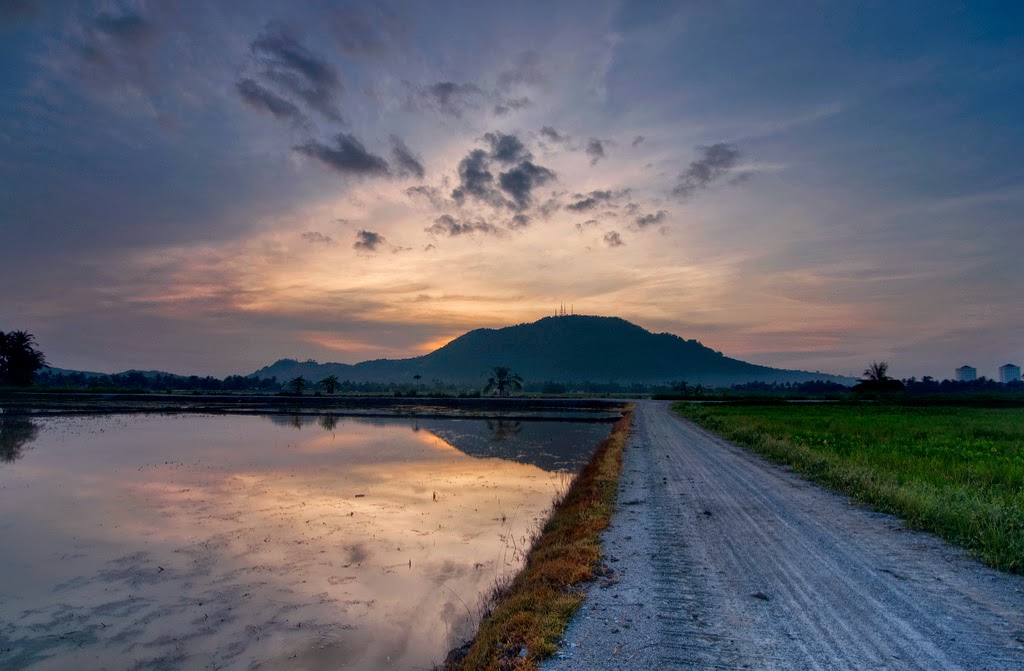
View of Bukit Mertajam Hill from a paddy field in Permatang Pauh

I had always been living in Bukit Mertajam until my family moved to Simpang Ampat when I was at the age of thirteen. Located in Seberang Perai in the state of Penang, Bukit Mertajam has always been a quaint little town that has its old world charm. It is a hidden gem that keeps drawing me back. The town has always been a part and parcel of my childhood days and it exudes my sense of home and belonging. Even though I no longer live there, I sensed that I have a personal connection with it.

What you may have not known is that this town produces many national personalities such as national badminton player Lee Chong Wei and former Prime Minister Tun Abdullah Ahmad Badawi. Datuk Seri Anwar Ibrahim was also born here.


Front courtyard of the Tua Pek Kong Temple in Jalan Pasar, Bukit Mertajam

The main feature of the town is a monstrous hill that gave the town its name, looming over the town below. Bukit Mertajam is a thriving town with bustling of business and trade. Lining the streets are quaint shops and small stalls selling groceries and local items. A Tua Pek Kong Temple lies in the heart of the town in which its temple courtyard becomes a public open space and cultural centre of the town. This temple is built to serve as a local guardian deity to the local community. Surrounding the temple there are roadside stalls selling popular hawker fare and tasty snacks. This temple is also a venue for many Chinese opera and musical shows where residents from all walks of life converge to enjoy the performance. Sundry shops, coffee shops, markets, bazaars, supermarkets and other enterprises surround the temple. Shops along the market street and the nearby railway station is the place where most of the business activities comes in full swing, especially in the morning. Bukit Mertajam Supermarket used to be located above the town’s market.

A few miles away out in the country side there are farmhouses where vegetables are cultivated. Nearby there are fruit orchards and paddy fields which is the town’s main agricultural produce.

This town is also never too far away from nature sites. A stone’s throw away from the hustle and bustle of the town is the Bukit Mertajam Recrational Forest, which transports me to greenery and serenity. The nature reserve’s lush vegetation is one of the hidden gem. Here, I visit the teahouses where I can enjoy various types of Chinese tea as well as herbal eggs, strolling under the rainforest canopy, hike up the hill via a forest track, or take a dip at the cascading streams.  At the summit of the hill, a scenic view of the town below and Penang Island in which I find it to be rewarding.

Perched on a hill slope there is a Buddhist monastery. Its pavilions, meditation huts and monks dwellings offer a scenic view of the hills and the town below, not to mention being surrounded by durian orchards. Its built environment augurs well with the local tropical climate, the work of nature high above in the hills provide cooling. It is an ideal place for those who want to seek compassion and wisdom.

In the valley below lies St. Anne’s Church which is home to the largest Catholic pilgrimage in the country. Another highlight of this church is the life-sized figures at Stations of the Cross. I would hike up to the nearby hillock next to the church where the grottoes are located.

Bukit Mertajam is a home to a melting pot of cultures, it is the centre of cultural exchange, not to mention the wide array of food and festivals you get to indulge in. Roadside stalls selling Hokkien Mee, Char Koay Teow, Yam Rice, Jawa Mee, Laksa, Koay Teow Soup, Mee Goreng Loh Shee Fun and Wanton Mee which are the popular hawker fare here. This town is also home to old school style Teochew cuisine. Different types of festivals are celebrate here, namely Chinese New Year, Wesak Day, St. Anne’s Feast and Hungry Ghost Festival.

I vividly remembered playing football with my friends from my neighbourhood by the river during my childhood days. Whenever there was a heavy downpour, the river burst its banks, causing the area to be flooded. My house was often inundated by foot-deep flood waters during the monsoon season, which compelled my family to move out of the town. Each time during the monsoon season my sisters and I would tuck up in the sitting room upstairs watching movies while eating instant noodles.


I also vividly remembered two secondary schools in Bukit Mertajam where I used to study, namely SMK Berapit and Bukit Mertajam High School. SMK Berapit is the alma mater of Datuk Lee Chong Wei while Bukit Mertajam High School is the alma mater of Tun Abdullah Ahmad Badawi. Bukit Mertajam High School sits on a hillock and there is a large school field which is known as Jacobs Green. Behind the school is a bungalow owned by a man who was once the richest man in the town by the name of Teh Cheok Sah. Behind the bungalow there is another hillock filled with lush vegetation where residents of the town go there for fitness and recreation. There used to be a community library atop the hill. 

These fun experiences and rich tapestry of lifestyle in this town has been deeply etched in my memories. 

Wednesday, September 9, 2009

Water Taxis In Penang


In view of the introduction of water taxis in Penang, the fellow Penangites are able to travel around Penang island and mainland faster if that takes off by the end of next year.

According to Penang Port Commission (PPC) chairman Tan Cheng Liang, who had suggested the idea, the coastal points are Bagan Ajam, Butterworth, Pulau Aman and Nibong Tebal which is on the mainland, Teluk Bahang, Tanjung Bungah, Tanjung Tokong, Weld Quay, Pantai Jerejak and Batu Maung on the island.

She added that the Federal Government, especially the Prime Minister, had approved the project in sync with the Northern Corridor Economic Region (NCER).

Water taxis has been operated by many major cities around the world, include Amsterdam, Auckland, Bangkok, Brisbane, Capetown, Chicago, Copenhagen, Dubai, Hamburg, Istanbul, Kobe, London, Manila, New York, Osaka, Oslo, Paris, Rotterdam, Seoul, Singapore, Sydney, Tokyo, Vancouver and Venice. Penang would be the first in Malaysia to have its very own water taxi.

I actually pledge in full support, as these water taxis is another form of efficient public transport which saves travel time for those people who are travelling from the mainland to the island. These commuters would not have to take the trouble to face traffic jams on the Penang Bridge which sometimes would take 45 minutes to get to the island, especially during peak hours.

Water taxis would be very useful to those who travel from Nibong Tebal or Bagan Ajam to Batu Ferringhi, which the usual journey either drive along the bridge or take a ferry and then a bus takes more than 2 hours.

With the implementation of the water taxi, they serve as an alternative public transport as it will ease the traffic congestion on roads and highways, especially on the Penang bridge. In this way, a proportion of travelling commuters would be diverted to water taxis.

Water taxis would also be useful as it also provides new job opportunities and boost the tourism industry.

Currently, the mainland and the South Seberang Perai district are deliberately being cut off from Penang island as not many tourists who visited Penang had even step on the mainland soil just to catch a glimpse of several tourism areas on the mainland, namely Pulau Aman, Bukit Tambun village, fireflies and food haven in Nibong Tebal.

However, there are several conditions to be considered before implementing the project. Feedback from residents living along the coast on whether the water taxis is a necessity to the residents should be considered, or otherwise, if the idea is mooted but the residents are showing their displeasure, then the water taxis facility would be gone to waste and the company who run the water taxis would end up losing money and gone bankrupt.

Besides that, environmental-friendly water taxis should be considered so as not to have any environmental impact. Jetties or pick-up points should be built in such a way that it would not bring any geographical impact. Furthermore, water taxi pick-up points are to be built at high population density areas and easily accessible to bus stops, convenience stores, tourist attractions, towns or roads. This is to improve the popularity of the routes.
Source: The Star online "Penang To Have Water Taxis" (updated 15 July 2009)