Showing posts with label Bukit Mertajam. Show all posts

Monday, January 25, 2016

Berapit Hill Thai Buddhist Temple

Berapit Hill Thai Buddhist Monastery (known in Chinese as Chanxiu Jingshe 禅修静舍) is located up on the western slopes of the Bukit Mertajam hill in Seberang Perai, Penang Island. This temple is rather well known among the locals but not tourists out of town. This monastery can be accessed by a 25-minute hike from the car park at the bottom of the hill. A pair of running shoes and a bottle of water is highly recommended as it is going to be a steep hike up the asphalt and concrete path through the dense jungle. The other Buddhist monastery is Vivekavana Solitude Grove which can be accessed through the same concrete path located at a higher elevation compared to this Thai monastery. 

Upon reaching the Thai monastery there is a large statue of a sitting Buddha and the main prayer hall. Several shrines dedicated to Luang Phor Tuad and Na Tuk Kong are also located next to the main prayer hall. If you continue hiking, you will reach the 5-tier pagoda and the meditation pavilion overlooking hill below with panoramic views of Bukit Mertajam town and Penang Island in the distance. Also located next to the pagoda are Phra Prom shrine and a large statue of a standing Buddha flanked by two elephant statues. 

View of Bukit Mertajam hill from the car park

Asphalt path leading to the hill

View of the temple from the bottom of the hill

Junction at midway along the concrete hilly path. To get to the Berapit Thai Buddhist Temple, take a left turn. Take a right turn and you will reach Vivekavana Solitude Grove. 

Sitting Buddha statue next to main prayer hall 

Miniature Buddha statues in the main prayer hall

View of Bukit Mertajam hill from the monastery

Telecommunications tower atop the summit of the hill 
View atop the pagoda
Panoramic view from the pagoda
Panoramic view of Bukit Mertajam town and Penang Bridge

Panoramic view of Seberang Perai and Penang Island

Pagoda at the monastery

View of the pagoda and the hill below
Panoramic view of Bukit Mertajam, Seberang Perai and Penang Island. 
Statue of the standing Buddha 
How to get there

Unfortunately there is no signboard leading to the Berapit Hill Thai Buddhist Monastery. To reach there from Bukit Mertajam town, drive along Jalan Berapit. After passing SJKC Jit Sin and SMK Berapit and before you reach the Berapit wet market on your right-hand side, turn right into Taman Pearl which then leads you to a residential road. Turn right into Tingkat Berapit 4, then turn left into Lorong Berapit 1 before turning right into Tingkat Berapit 7. You will see a car park behind the residential area where you can park your car before you ascend the hilly path leading to the monastery. 

Monday, January 18, 2016

D.O. Hill Recreational Park

Taman Rekreasi PBAPP Bukit D.O. (D.O. Hill Recreational Park) is a recreational park and green lung in the heart of Bukit Mertajam in Seberang Perai, Penang. The park can be accessed from Jalan Sri Bukit either via Jalan Permai or Jalan Chan Ewe Pin. The park was recently upgraded by the Penang state government with added facilities such as outdoor gym, jogging track, reflexology path and gazebos. You can see Penang Island and Prai from the summit of the hill. The park has ample parking space and popular with locals especially working adults and retirees. However I do feel that the authorities should create more parks around Seberang Perai area to cater the growing population. 

View from the summit of the hill

View from the summit of the hill

Jogging track at the park 

difference of A2 Hosting and IX Web Hosting

Wednesday, January 21, 2015

Suling Hill

Suling Hill is a private hilltop retreat near Mengkuang Dam, Bukit Mertajam. Although this place is a privately owned property, it is open to the public to enjoy the facilities and benefits the hill has to offer. The hill includes a observatory platform, reading room, conference room, bathroom, chalets and a durian orchard. The hill offers a breathtaking view of Mengkuang Dam, Butterworth-Kulim Expressway, Kampung Mengkuang, Sungai Lembu and Bukit Mertajam Hill. The hill commands a picturesque and enthralling view of the natural landscape as far as the paddy fields in Permatang Pauh and the sunset. Among the activities that you can do here include camping, mountain biking, picnicking, hiking and savouring local fruits. This rural retreat is still largely unknown to many urban dwellers. Suling Hill offers a wide variety of local fruits such as durian, rambutan, nutmeg, mango and mangosteeen which are cultivated on this hill. 

If you are travelling from Bukit Mertajam, the hill can be reached through Jalan Berapit towards Mengkung Dam. The moment you reach the traffic lights at the end of Jalan Berapit, turn right and shortly after that, turn left into a small, narrow road which bears the Suling Hill signboard, follow the signboard up the steep slope until you reach the summit. 


If you are travelling from Butterworth and Penang Island, take the Butterworth-Kulim Expressway until you exit at the EXIT1505 Tasik Mengkuang interchange which bears the signboard that leads to Penanti and Berapit. When you reach the traffic lights, turn right. After 1.3km you will reach a small, narrow road on the left just before the Kampung Mengkuang traffic light junction. You will see a signboard that leads to Suling Hill. If you have a smartphone, you can use Waze, a navigation app which can lead you to the place. 


Nandaka Vihara

Nandaka Vihara is a Theravada Buddhist vihara (monastery) located at the foothills of Bukit Mertajam Hill in Cherok Tokun, Bukit Mertajam, Penang. Very much unknown even to the locals, it is established primarily for practice of mediation. The monastery features a dana hall, meditation hall, monk's residence, gazebo for meditation and a liberation pond. You could see the monstrous Bukit Mertajam hill looming over the monastery a washed by durian orchards. 

The Buddhist monastery can be reached through Jalan Kolam, which is a road that leads to Hutan Lipur Bukit Mertajam (Bukit Mertajam Forest Reserve). Just before you reach the forest reserve, there is a small, narrow road that branches to the right next to a Chinese temple. 


The moment you reach Nandaka Vihara, you would be greeted by durian trees which surround the monastery. Beside the car park there is a small shrine and a dana hall which is in the main building of the monastery. 


Next opposite the main building there are several meditation pavilions dotting along a small path which also leads to a small bridge over a liberation pond. The open air pavilion augurs well with the local tropical climate, the work of nature high above in the hills provide cooling, hence there is no need for any air conditioning. 


Also beside the main building there is a pathway which leads uphill to other meditation pavilions. The pathway begins at a gateway with a landscaped garden. There is a bodhi tree on the left side of the gateway. 


The meditation pavilions on the hill slope are accessible through a ramp by motorcycle and staircases. On the way up the hill, you can see a panoramic view of Cherok Tokun and Bukit Mertajam Hill, as you can see in the photos below. The pathway ends at Ehipassika Sima Hall, which is a large meditation hall. 


Just as you would think it's a paradise rainforest resort, wait until you start living here. In actual fact, people come here to seek hardship. This reflects the harsh reality of life and suffering as part of the First Noble Truth. 

An ideal place for people who want to seek compassion and wisdom.

Saturday, July 5, 2014

Bukit Mertajam


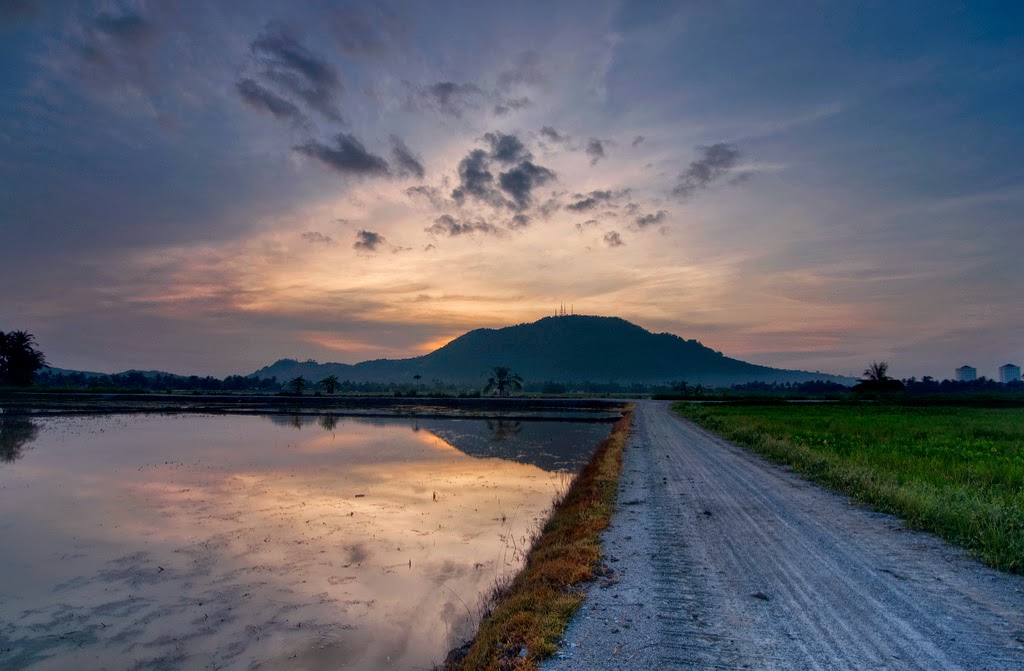
View of Bukit Mertajam Hill from a paddy field in Permatang Pauh

I had always been living in Bukit Mertajam until my family moved to Simpang Ampat when I was at the age of thirteen. Located in Seberang Perai in the state of Penang, Bukit Mertajam has always been a quaint little town that has its old world charm. It is a hidden gem that keeps drawing me back. The town has always been a part and parcel of my childhood days and it exudes my sense of home and belonging. Even though I no longer live there, I sensed that I have a personal connection with it.

What you may have not known is that this town produces many national personalities such as national badminton player Lee Chong Wei and former Prime Minister Tun Abdullah Ahmad Badawi. Datuk Seri Anwar Ibrahim was also born here.


Front courtyard of the Tua Pek Kong Temple in Jalan Pasar, Bukit Mertajam

The main feature of the town is a monstrous hill that gave the town its name, looming over the town below. Bukit Mertajam is a thriving town with bustling of business and trade. Lining the streets are quaint shops and small stalls selling groceries and local items. A Tua Pek Kong Temple lies in the heart of the town in which its temple courtyard becomes a public open space and cultural centre of the town. This temple is built to serve as a local guardian deity to the local community. Surrounding the temple there are roadside stalls selling popular hawker fare and tasty snacks. This temple is also a venue for many Chinese opera and musical shows where residents from all walks of life converge to enjoy the performance. Sundry shops, coffee shops, markets, bazaars, supermarkets and other enterprises surround the temple. Shops along the market street and the nearby railway station is the place where most of the business activities comes in full swing, especially in the morning. Bukit Mertajam Supermarket used to be located above the town’s market.

A few miles away out in the country side there are farmhouses where vegetables are cultivated. Nearby there are fruit orchards and paddy fields which is the town’s main agricultural produce.

This town is also never too far away from nature sites. A stone’s throw away from the hustle and bustle of the town is the Bukit Mertajam Recrational Forest, which transports me to greenery and serenity. The nature reserve’s lush vegetation is one of the hidden gem. Here, I visit the teahouses where I can enjoy various types of Chinese tea as well as herbal eggs, strolling under the rainforest canopy, hike up the hill via a forest track, or take a dip at the cascading streams.  At the summit of the hill, a scenic view of the town below and Penang Island in which I find it to be rewarding.

Perched on a hill slope there is a Buddhist monastery. Its pavilions, meditation huts and monks dwellings offer a scenic view of the hills and the town below, not to mention being surrounded by durian orchards. Its built environment augurs well with the local tropical climate, the work of nature high above in the hills provide cooling. It is an ideal place for those who want to seek compassion and wisdom.

In the valley below lies St. Anne’s Church which is home to the largest Catholic pilgrimage in the country. Another highlight of this church is the life-sized figures at Stations of the Cross. I would hike up to the nearby hillock next to the church where the grottoes are located.

Bukit Mertajam is a home to a melting pot of cultures, it is the centre of cultural exchange, not to mention the wide array of food and festivals you get to indulge in. Roadside stalls selling Hokkien Mee, Char Koay Teow, Yam Rice, Jawa Mee, Laksa, Koay Teow Soup, Mee Goreng Loh Shee Fun and Wanton Mee which are the popular hawker fare here. This town is also home to old school style Teochew cuisine. Different types of festivals are celebrate here, namely Chinese New Year, Wesak Day, St. Anne’s Feast and Hungry Ghost Festival.

I vividly remembered playing football with my friends from my neighbourhood by the river during my childhood days. Whenever there was a heavy downpour, the river burst its banks, causing the area to be flooded. My house was often inundated by foot-deep flood waters during the monsoon season, which compelled my family to move out of the town. Each time during the monsoon season my sisters and I would tuck up in the sitting room upstairs watching movies while eating instant noodles.


I also vividly remembered two secondary schools in Bukit Mertajam where I used to study, namely SMK Berapit and Bukit Mertajam High School. SMK Berapit is the alma mater of Datuk Lee Chong Wei while Bukit Mertajam High School is the alma mater of Tun Abdullah Ahmad Badawi. Bukit Mertajam High School sits on a hillock and there is a large school field which is known as Jacobs Green. Behind the school is a bungalow owned by a man who was once the richest man in the town by the name of Teh Cheok Sah. Behind the bungalow there is another hillock filled with lush vegetation where residents of the town go there for fitness and recreation. There used to be a community library atop the hill. 

These fun experiences and rich tapestry of lifestyle in this town has been deeply etched in my memories. 

Tuesday, June 19, 2012

History of Bukit Mertajam

Briefly translated and modified from source: 王琛发 (2008), 大山脚历史,Zoom Penang. URL: http://zoompg.com.my/forum.php?mod=viewthread&tid=32, retrieved 19 June 2012. 


Brief History
Bukit Mertajam is town in the Malaysian state of Penang, located in Central Seberang Perai, with the Chinese community forming the majority of the total population. Jit Sin High School is one of the top performing schools in Malaysia. The town is also famed for the St. Anne’s Catholic Church, with its annual St. Anne’s Novena and Feast being held every year at the end of July which attracts thousands of devotees from all around the country.
As a major town in Central Seberang Perai, Bukit Mertajam serves as one of the many economic hubs in the northern region.

Hundred years ago, Bukit Mertajam is merely a barren wasteland filled with wild animals and swampy marshlands infested with crocodiles.
Although so far there is no complete written record on the early settlement of Bukit Mertajam, archeologists had recently discovered much evidence on the antiquity of the town.

According to archeological findings, there has been early settlement of Bukit Mertajam some 1500 years ago in the 5th century based on the discovery of the Cherok Tokun Relics, which is a stone tablet carved with ancient Sanskrit writings, which is now displayed in the church grounds of the St. Anne’s Church along Kulim Road.

Based on the early Chinese settlers of Bukit Mertajam, the urban planning of the old section of the town was established in 1886 by the Hock Teik Cheng Sin temple community, with the Pek Kong Temple as a town core while the shops, markets and bazaars radiating around the temple.

The Hock Teik Cheng Sin Temple along Pasar Road not only serves as a centre for Chinese folk religious worship, but also functions as an administrative body for the Chinese community, which consists of four clan associations. At that time, the temple community is responsible for the economic and social welfare of the Chinese community including schools, graveyards, events, social activities, and properties.

The Chinese community in Bukit Mertajam is mostly from the Teochew clan. They hail mostly from Huizhou, Guangdong, China and speaks the Teochew dialect. The Teochews once made up nearly half of the total population in Seberang Perai.

Antiquity
In the Malay archipelago during the 1st and 6th century is known as the Indian cultural era in which Malay kingdoms at that time embraced Hinduism. Evidence arising from the discovery of the Cheork Tokun Relics has shown that the early settlers of Bukit Mertajam have Hindu influence.

The Indians have long discovered the Malay Peninsula. In Indian literature which is known as the Ramayana text, they had referred to the Malay Peninsula as Suvarnabhumi (Land of Gold). During the 3rd century AD, the Indians begin to trade in the Malay Archipelago regions. These traders are mainly from the Southern Indian kingdom of Chola and Pallava. Soon the Kedah plain has large influences of Hinduism and Buddhism with the construction of many temples and candis. Kedah kingdom had been the trading hub and centre of Hindu civilization in the Malay Archipelago region. Paddy is mainly cultivated in Bukit Mertajam during that period.

The region of Bukit Mertajam is followed by Thai influence during the 18th century. During this era, Bukit Mertajam existed as a quaint Malay village which is based on paddy cultivation. However, these villagers were either persecuted by the Siamese or had fled.

Early Discovery
According to the Huizhou clan association, the town’s history can be traced back to 1822 when the immigrants from Huizhou begin to settle in Penang, involving in farming. Agriculture was once a major industry in Penang.
When Sir Francis Light discovered Penang in 1786, Penang has become a centre for spice trade in the East Indies to supply the European market. Then there was a ten-year conflict between the Dutch and the British in South-east Asia. In order to dominate the spice trade and prevent from further and supply disruptions, the British has started the cultivation of spice in British colonial settlements like Province Wellesley.

Major Forbes Ross MacDonald was the superintendent of Prince of Wales Island (Penang Island) in 1799. In his report, he brought in the Huizhou people and assisted them by providing transportation to travel to Penang from their homeland, land for cultivation, housing and social welfare. This has opened up the floodgates for more Chinese to venture into farming in Province Wellesley. At that time, many people in the Huizhou region in China suffered from famine, drought and violence due to land disputes. People from Huizhou came to Penang to look for greener pastures.

In June 1800, the Huizhou people began to settle within the vicinity of the present day Bukit Mertajam. Earlier in that year, the first Lieutenant-Governor of Prince of Wales Island, Sir George Alexander William Leith, had negotiated a further treaty with the Sultan of Kedah for the cession for a strip of land in Kedah in the mainland which is later known as Province Wellesley. Province Wellesley is named after Richard Wellesley, the Governor-General of India.
Before East India Company gained control of Province Wellesley, the Chinese had already begun their sugarcane plantation in Batu Kawan. In 1800, seeing the high demand of herbs and spices in Europe, the British had encouraged the residents of Bukit Mertajam to grow various spices such as pepper, cloves, cinnamon and nutmeg. Besides agriculture, the residents of Bukit Mertajam begin to engage in alternative income such as quarrying.

It is known that during the 19th century Bukit Mertajam is the largest producer of granite in the Northern region. At that time, the quarrying areas in the town are the areas surrounding St. Anne’s Church and Berapit. Granite was used to construct the Penang prison in the island. They were transported by ferrying the rocks across the sea. Huizhou people had been dominating the granite quarrying industry until the Second World War.
During the 1930’s the Chinese began mass plantation of sugarcane in Bukit Mertajam as a source of sucrose to be exported to England. Sugarcane plantations are concentrated in key areas in Bukit Mertajam surrounding the town area and Bukit Mertajam High School near the railway tracks.
The rivers and streams that flow from the Bukit Mertajam hill into the low plains are now replaced by the large urban drainage systems to cope with the large amount of storm water. Around the newly built temple which is constructed along the river bank, the Huizhou people first settled as farmers in hilly terrains, farming lands, as well as hills. The marketplace is established with hillocks surrounding the valley with the river flowing through the centre.

The region surrounding Bukit Mertajam during the spice trade era in the 19th century is only accessible by boat and junk. Sungai Juru and Sungai Rambai was the main transportation waterway in the town, with Sungai Rambai and Padang Lalang regions were the main harbour that served the town. There was no land transportation that connects the town, except mud roads that lead to Butterworth. Therefore, all trades and products such as spices and granites have to be transported through the river.

Early Development
Records have shown the demographics of Seberang Perai in 1861, which at that time has a total population of 64000. Ethnic breakdown is as follows: Europeans 76, Malays 56236, Chinese 7204, Indians 3515 and Siamese 186. Majority of Malays settle in the northern portion of Seberang Perai as fisherman and farmers, while the Bengalis involve in the livestock industry. Many Chinese conduct business in the town areas, especially in Bukit Mertajam.
In 1899, rubber plantation has replaced the sugarcane plantation. During that time, the railway system that connects Prai, Nibong Tebal and Bukit Mertajam has been completed. The railway track which connects Kuala Lumpur and Singapore has been completed in 1909, making railway as the main transportation system. In 1914, rubber is the main production in Bukit Mertajam.

With the rapid development and improvement of the transportation system, the population of the town increased dramatically. The first Malay vernacular school was set up in 1800 in Cherok Tokun. Another Malay school was opened in Sungai Rambai 3 years later. The first Chinese vernacular school, Jit Sin School, was opened in 3 March 1918. Jit Sin School was first established by the Hock Teik Cheng Sin Temple committee along Jalan Pasar. Hock Teik Cheng Sin had purchased 120,000 dollars worth of land for the building of the school. Bukit Mertajam High School was first opened in 1927, the Convent school was founded in 1931, while Kim Sen School was established in 1939.

The first motorcar in Bukit Mertajam was in 1920. By 1930, there are 15 private motorcars owned by the residents of Bukit Mertajam.

Development had been slow before the Second World War. In 18 December 1941, the Japanese troops attacked Pearl Harbour with Indochina as their military base. Japanese troops first landed in Kota Bharu, Songkhla and Pattani by sea in the same year and then travelled by land to conquer Malaya. 

On 17th December Japanese troops conquered Penang, and at the same time Bukit Mertajam was also affected. Before the British retreat in 1941 the railway station in Bukit Mertajam had been blown up. The railway station was constructed again in 1942 by the Japanese and uses Bukit Mertajam High School as a military base. At that time, Bukit Mertajam High School was forced to close down.

After the Second World War had ended in 1945, Bukit Mertajam had been a thriving town with bustling of business activities and trade. Development was rapid. Entertainment such as Cinemas and theatres and were opened between 1956 and 1957.

There is significant urbanisation of the town in 1957 which started as a village and later developed into a major urban area. Recent development is followed by establishment of new townships such as Taman Sri Rambai, Taman Kota Permai, Taman Desa Damai, Taman Alma, Taman Sentosa, Taman Bukit and Taman Tenang and Taman Mutiara.

The new hospital along Kulim Road was built in 1960; the new post office was built in 1968, while the new train station was built in 1983.
Today, Bukit Mertajam is one of the trading and economic hubs in the northern region in Peninsular Malaysia.